Erna Bennett - author, pilot, communist, plant geneticist, fighter and friend

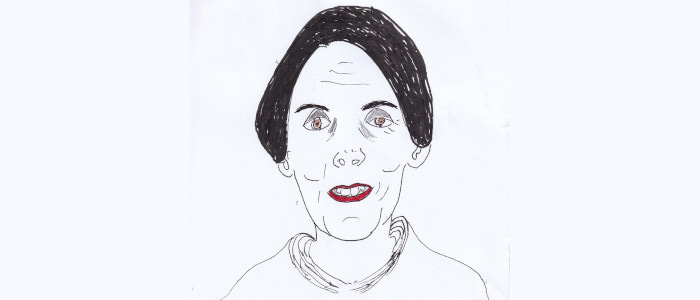
Erna Bennett was a 6 feet 3 inch tall Irish Communist, born in 1925, who lived at 252 Bathurst Road Katoomba in the early 1990s, went to Greece for a year and returned to Katoomba for a while before heading to Italy and finally Scotland.
Not particularly interesting, I know, but what if I told you that early in the Second World War, as a 17 year old, one year below the legal age, she joined the British Air Force and became a pilot, deserted mid-war to fight with Greek partisans, joined the Food and Agricultural Organisation (the United Nations FAO), invented the term genetic conservation, fought the Green Revolution’s attack on local farmers, took over the FAO in a massive battle with seed conglomerates and petrochemical companies and then came to Katoomba.
This is her story or the parts I can put together.
Much of what follows is based on an interview that the ABC’s Gregg Borschmann conducted with Erna on 21st November 1994, over four and a half hours, at her home in Katoomba. I acquired this from the ABC archives for $85 late last year. 1
Where quotes are in bold, italics and unattributed, they belong to Erna as part of this interview.
Let’s start with Erna the pilot. She’d had rudimentary training through the Air Training Corp2 and fudged her application to get into the British Air Force. She appears to have done some flying but just how much is not clear.
The depiction of her war engagement as a member of the “British Air Force” is something that she resented. As a proud Irish woman, she preferred the term Allied Forces which was the more commonly used at the time and mirrored its international composition. She also wore an Irish badge on her uniform until told to remove it.
Later in the war, because she spoke Greek (How? I don’t know), she was posted to the Special Services in Greece where she joined the partisans much to the dismay of British authorities.
Erna described how British interests had negotiated with the city governors of Thessaloniki and Athens, still under German occupation, to ensure a post-war takeover that was favourable to Britain.
We really shouldn’t be surprised by this level of collusion. The war doesn’t seem to have caused much disturbance to finance at the highest levels as Adam Lebor explains in his book: “The Tower of Basel”.

”During the war, the BIS became a de-facto arm of the Reichsbank, accepting looted Nazi gold and carrying out foreign exchange deals for Nazi Germany. The bank’s alliance with Berlin was known in Washington, DC, and London. But the need for the BIS to keep functioning, to keep the new channels of transnational finance open, was about the only thing all sides agreed on. Basel was the perfect location, as it is perched on the northern edge of Switzerland and sits almost on the French and German borders. A few miles away, Nazi and Allied soldiers were fighting and dying. None of that mattered at the BIS. Board meetings were suspended, but relations between the BIS staff of the belligerent nations remained cordial, professional, and productive. Nationalities were irrelevant. The overriding loyalty was to international finance”.
Within two months of the British post-war occupation the resistance movement was crushed:
“by an extremely ruthless military repression so that by the end of 1945-46, the resistance movement was anathema … into Athens morning after morning after morning came truckloads and truckloads and truckloads packed with 20 or 30 heavily armed what they would nowadays call paramilitaries”. 3
What followed was a terror campaign directed against anyone associated with the resistance with the complete cooperation of the British police force and army stationed there.
This jaunty part of Erna’s life led to her subsequent trial for desertion and possible execution. She was saved by the intervention of her father who was the Assistant Chief of the British mission in Greece at the time. This makes family disagreements over Covid-19 and the jab appear petty. She was now 22 years old.
After the war, she worked, briefly, in Yugoslavia as a journalist for the AFL-CIO while attempting to get back to Greece.4 This proved impossible so Erna returned to London and applied for an ex-service grant to study Botany specialising in genetics and physiology. Erna graduated in 1953.
She was then offered a research post at university at a subsistence wage, rejected the offer and took up teaching for a couple of years. She was then offered a job at the Rhodesian Tobacco Association5 studying nematodes. This appointment was then cancelled without any explanation. Erna’s past misdeeds were catching up with her.

In the 1950s, she entered a difficult phase of her life where her Communist label travelled with her closing many doors. She described it as a time of “immense personal difficulty” and chided Communist friends who “chose survival over spiritual purity”. She described being a Communist as being “more expensive than being a member of the most exclusive club”.
Communism and Communists were perceived as a threat to governments with their bringing “the means of production” under the control of Soviets with their technocratic vision of fairer, planned distribution of resources.
It is strange to look at the attitude to Communism in the 1950s. People like Bruce Milliss, a Katoomba businessman and Ben Chifley’s campaign manager for a time, lived in fear of an ASIO representative knocking on his door. Similar anxieties even extended to his son, Roger. It was a little like the experience of being anti-Covid vax between 2021-23 and then suddenly it was OK to question again. Much the same, being a Communist today has acquired a celebrity status in some circles.
Back to Erna. It was around this time she had her big break and gained a job at Scientific Officer Grade at the National Library for Science and Technology in England. Because of her past record the job was offered to her at the low Experimental Officer Grade. She had to take it. Her options were poor.
She then gained a job at the Scottish Plant Breeding Station under the supervision of a man she described as the father of quantitative gene ecology, James Gregor.
Gregor’s critical discovery is that changes in environment can produce minute changes in genetics which can become significant over time. He emphasised the ability of plants to adapt to environmental changes much faster than had been recognised before his work.
Erna credits Gregor with introducing her to the work of Russian geneticist Nikolai Vavilov 6 and Eugeniya Sinskaya 7 whose work on species formation informed their work.
With Gregor’s encouragement, she produced two papers in 1964 and 1965 of over 100 pages in which she coined the term genetic conservation. Subsequently, she was invited to organise a conference in Rome on that subject in 1967. Her time was now split between her work in Scotland and secondments to the FAO.
Here is the core of Erna’s story and where things get really interesting.
The 1967 conference was inspired by field research that showed enormous displacement of local seed varieties by the Green Revolution seeds in countries like Turkey, Pakistan, Greece, south-east and central Asia and this displacement was happening at a much greater pace than people realised. The search for resistance genes in natural varieties was becoming increasingly difficult.
Erna described the impact of these invasive Green Revolution varieties as:
“murderous in its impact on local diversity”.

At that conference Erna stated;
“The purpose of conservation is not to capture the present moment of evolutionary time, in which there is no special virtue, but to conserve material so that it will continue to evolve. Such ‘continued evolution’ could only be possible in in situ collections.”
In her talk with Gregg Borschmann she lamented the fact that the human contribution to plant conservation has been downplayed and yet it has been the main protector of genetic diversity.
”The number of varieties created since the beginning of time created by natural evolution is very impressive, yes, I mean no-one is going to deny it but I would say it’s not quite so impressive as this explosion of evolutionary activity that man kicked off which is not at all surprising because the one thing that man did as a cultivator was to diversify the environment and the process of diversification led to a process of diversity and evolutionary responses so that, as I say, from village to village, from valley to valley and from climate to climate and from cultivation type to cultivation type different varieties of crop land have arisen”. 8
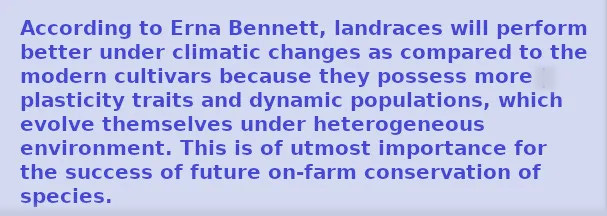
In the above quote from a Science Direct article, Erna seems to be challenging the climate change solution of locking up seeds. 9 This fits with the Jim Gregor position stated above that genetic diversity is better preserved in situ.
She went on to describe debates at her Scottish headquarters on the subject of adaptive resistance of crops to pathogens, sometimes called field resistance. The capacity of pathogens to morph through multiple generations in a year producing billions of offspring challenges the idea of laboratory produced crop strains. These may prove resistant for a time but then a breakthrough generation of pathogens will prove these efforts futile.
Take that in. Please take that in. So what our experts are doing is locking this genetic diversity up in a vault in Norway where no natural genetic adaptation can take place. Meanwhile, they are propagating the 60% of patented crops with the aid of 75% of the pesticide market that they own. See The Doomsday Vault 10

Today, sane people are forced to listen to the modern day conservationist who supports the idea of our genetic diversity being scooped up, locked up and made bullet-proof in a laboratory. That is the end result of these Sustainable Development Goals. Synthetic equals Sustainable.
That is the key point made in Kate Mason’s November 2024 article on Regenerative Agriculture. 11 Synthetic equals Sustainable. Our future crops won’t be allowed to adapt to their environment. They are too fragile to stand against “the great climate change threat”. Instead, people with no clear understanding or care for the impact of the genetic manipulation of our food sources will continue to bombard crops with pesticides to guarantee their survival. Are you buying this?
The suppression of local seed stocks in the 1960s saw petrochemical companies buy up thousands of local seed banks. These companies actually make their money in the sale of pesticides. Erna’s field research and contacts gave her an extensive understanding of this development. In attempting to save them, she and colleagues spent most of 1968-69, in Afghanistan and then Sicily, in the field collecting germplasm
It is in the 1970s that her struggles inside the FAO metastasized. She describes how few of the people she was working with realised the impact of the Green Revolution which culminated in what she called a “free-for-all” for the seed companies. Erna:
”All my colleagues in the UN, almost without exception, not without exception, are very altruistic people” 12
Erna’s troubles inside the UN / FAO were not helped when she wrote a report on failed Green Revolution crops in Iran. The report was suppressed and she was given no reason. Contacts in Greece also told her of Credit Banks that would lend only for cultivation of the “Green” varieties. This led almost to the crowding out of native varieties.
This report has been very well buried including any references to it.
Eight years later, she joined a TV documentary team in Greece and reported on how farmers had turned their back on company seeds and had gone collecting in the mountains and were happily cultivating seeds adapted to their conditions.
Brown Boveri comes a’knocking
Borschmann then asked how she felt about the suppression of the Iranian report. It was suppressed by lobbyists from seed companies operating inside the United Nations. What evidence did she have. Direct evidence because these lobbyists from companies like Brown Boveri regularly came knocking on her door.
Representatives of seed companies would visit asking about the location of germ plasm collections:
”One of these was, in fact, an old friend of mine. An old colleague from the Scottish Plant Breeders Station who had moved to working for one of the private seeds companies and had become head of their germ plasm department or something and he wanted to know the location of germ plasm collections.
Erna: But why? What do you want to know for? We publish the locations in all our publications.
Colleague: I have been asked to make offers for those collections.”
Pressure was increasing on Erna from lobby groups and there was growing pressure from her superiors at the FAO.
She described her immediate superior as a buffoon who knew nothing of the work she and her colleagues were doing but he was extremely efficient in writing the kind of “bureaucratise he had learned in the Belgian colonial service”. She explained he was put there to be her boss because women could not be bosses, at that time.
Conversely, the Director-General of the FAO was a German “dynamo” who was constantly pushing down instructions aimed at shaping Erna’s work. This included urging her to meet with seed companies and insisting that she curb her criticism of them in reports and correspondence. This is unsurprising. As a donor nation, German nationals were among the most influential forces within the United Nations.
Much like the high tech solutions being sold to us now, the sales pitch behind the Green Revolution was that it was all about addressing world hunger. Meanwhile, the headquarters of the body with prime responsibility for pushing the Green Revolution seeds, the World Seed Programme13 was two doors up from Erna’s office.
Borschmann then asked whether she considered resigning based on the suppression of her work and her treatment generally. She replied that the United Nations still had a degree of answerability to government that doesn’t exist outside the system. She was clear about this system’s flaws but decided to try to achieve what she could within it.
This is a position biologist and Phd, Jonathan Couey, affirms in relation to regulatory agencies like the US FDA. He argues that their enemies in Big Pharma want them neutered then abandoned. 14
15
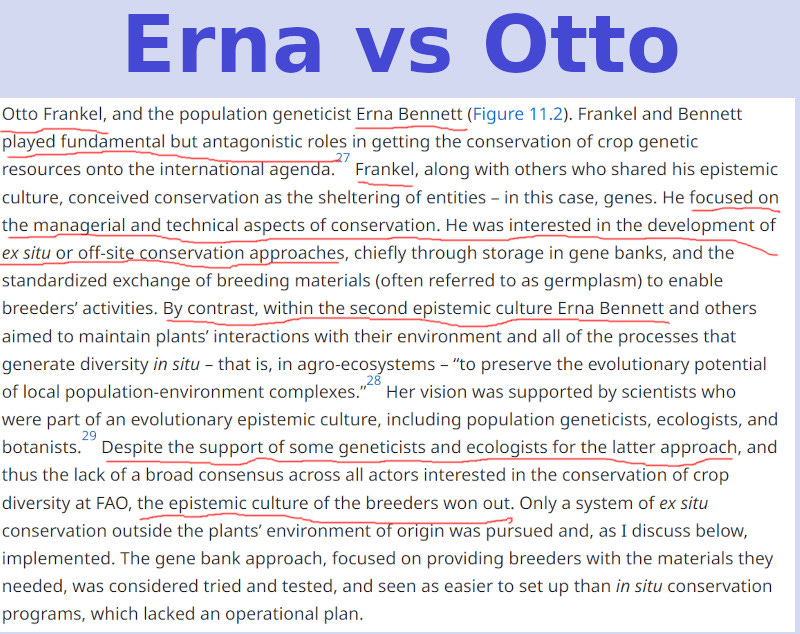
Meanwhile, she and colleagues grew concerned about lack of funding for the essential gene research her section of the FAO was doing. In 1972, a solution was proposed at a meeting attended by Erna, other members of the FAO’s Plant Exploration Working Committee and some very influential players such as Otto Frankel, in Beltsville Maryland. There it was proposed that:
”the CGIAR should set up an international board for plant genetic resources, which would operate within the UN system, and funds would be fed into that from CGIAR. I totally and utterly and unequivocally opposed that. It led to extremely sharp divisions and it led to my being totally excluded from any procedures of any sort connected with this work or any other work that I did for at least two, two and a half years”. 16
Erna Bennett
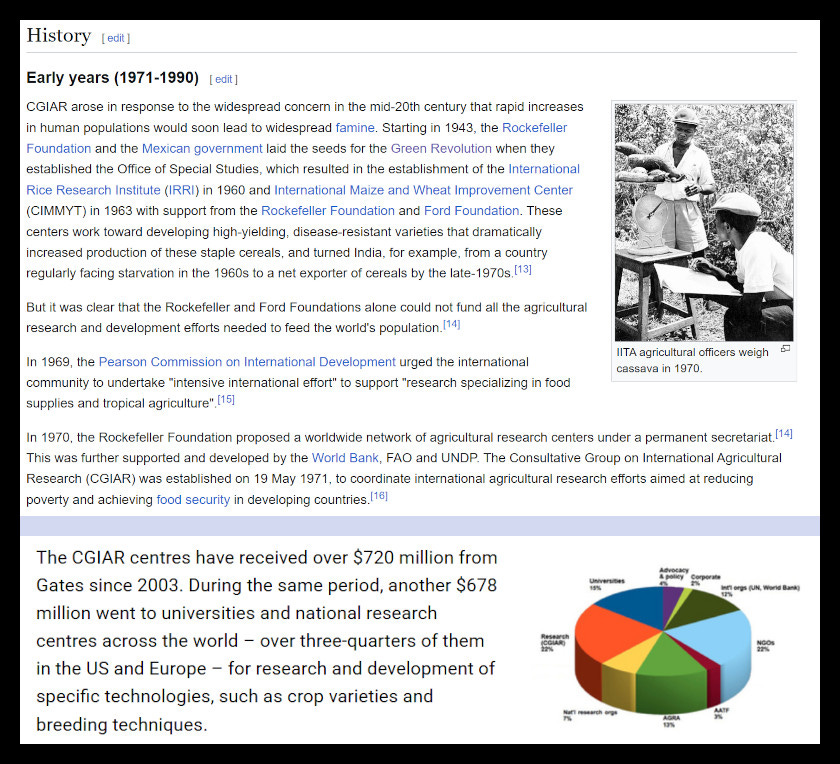
It might help our understanding to take a brief detour into where the CGIAR (Consultative Group for International Agricultural Research) came from and the sort of people central to its funding today. The Rockefeller and Ford gangs have had a very long term and deep interest in stalling “rapid increases in population”.
Have their concerns really been about the future fears of widespread famine or aiding them? The record of their involvement in everything from the environmental psyops to their deep interest in food production and global health marks them very harshly. Their interest in eugenics extends back to the beginning of the 20th century.
Erna truly was committed to addressing the issue of poverty and hunger. Perhaps, it was her honest intention to address this problem that made her the enemy of powerful people.
Erna knew who she was fighting. It is time for more of us to wake up to who the enemy is too.
17
The CGIAR has since scrubbed its history from its website but more information is available from our friend the Wayback Machine which explains:
”The [Rockefeller and Ford] Foundations, on their own, were not able to support international agricultural research in perpetuity. Hence, the Foundations together with the heads of FAO, UNDP, and the World Bank sought to persuade influential donors that agricultural development and, therefore, agricultural research, deserved high priority on the international development agenda.
This resulted in a series of policy consultations in 1969-1971 at which the goals of international agricultural research, financial support for research, and a suitable mechanism to harmonize these efforts were discussed. Most of these consultations were held at Bellagio, and all of them came to be known as Bellagio Conferences.
Among the policy makers who collaborated in this effort were Addeke Boerma (FAO), Sir John Crawford (Australia) 18, John Hannah (USAID), George Harrar (Rockefeller Foundation), Forrest "Frosty" Hill (Ford Foundation), Paul Hoffman (UNDP), David Hopper (Canada/IDRC), Robert McNamara (World Bank), Maurice Strong (Canada/CIDA) and Sir Geoffrey Wilson (UK)”. 19
Erna had some very pleasant company here. Including former US Secretary for Defense who described the US experience in Vietnam as one of good intentions gone awry.20 And the lovely Club of Rome’s Maurice Strong, 21former WWF Vice President and lackey for Princes Bernard and Phillip. He was also Secretary-General of the 1972 United Nations Conference on the Human Environment. One last mention for Sir John Grenfell Crawford, agricultural economist, who lived on the bus route from my childhood home. Have you heard of him?
She vigorously opposed the CGIAR plan which planned to remove seeds from their natural local environments to centralised locations where they could be picked off by petrochemical interests.
Crop Trust explains this as a happy little story of collaboration between Erna and Otto Frankel, with whom she had co-authored a book in 1970. 22 As explained above. the facts are at sharp variance to that narrative. The Beltsville meeting resulted in the formation of the International Board for Plant Genetic Resources (IBPGR) in 1973. In recognition of his fine work the IBPGR set up the Vavilov-Frankel fellowship program for scientists entering the plant genetics field.
ERNA BRINGS THE DIRECTOR-GENERAL TO HEEL
This was a turning point in the fight. A new head of the Crop Genetic Unit was appointed to oversee Erna’s work and no correspondence was to be sent or received by her without his inspection. She must not conduct any programmes or initiatives and not attend any meetings unless ordered by him. From this moment on Erna was paid to do nothing.
In response, Erna explained that she hystericked, complained, challenged and much more but it made no difference. Just at this time an election was held for the Staff Council and as her time was not occupied she put herself forward and was elected to this body with a very large vote. She was then elected President of the Council.
For the next three years she was engaged in internal politics. The Council led a strike and won all the conditions they sought. A Joint Action Committee was then formed which held the right of approval over every Director-General bulletin, every document he issued, every policy statement before he could publish any of them.
Erna describes that she and her colleagues on the Committee actually ran the FAO during the year following the strike.
This placed a very heavy load on this under-resourced and “unpopular” committee which had Erna working each day from 6am till after midnight. Eventually, this routine, “fueled alternatively by coffee and chamomile tea”, became too heavy a load and the committee relinquished these onerous responsibilities to the great relief of FAO management and seed companies.
During the period of this Joint Action Committee, Erna was offered all the positions she had been denied if she would only “give up this underserving activity, this unseemly activity where I really wasn’t appreciated” . She describes this as being offered with blatant insincerity by people who had spent years undermining her work. They sought to “buy their power back”.
When she returned to her former role, Erna found the FAO was dominated by the IBPGR, a body set up by the CGIAR - Erna hated acronyms - to collect, manage and store germ plasm collections. In 1993, IBPGR became the International Plant Genetic Resources Institute (IPGRI) and by 1994, according to Wikipedia, had become an “independent operation as one of the centers of the CGIAR”. Yes, I am laughing too.

This quote is taken from “The Seeds of the Earth”. I could find no other direct reference to it. 23

But this article makes clear Erna’s well-placed concerns:
”In July of 1980 the legislation took full effect and 2,126 vegetable varieties became illegal to sell in England and the other Common Market countries which belong to UPOV. Dr. Erna Bennett, formerly with the Crop Ecology and Genetic Resources branch of the United Nations’ Food and Agriculture Organization (FAO) in Rome, estimated that by 1991 fully three-quarters of all the vegetable varieties now grown in Europe will be extinct because of attempts to enforce plant patenting laws”. 24
Erna explained that even the educational institutions were being corrupted with:
Crop Husbandry becoming Crop Production
Soil Husbandry was now Soil Production
Animal Husbandry was Animal Production
She described soil as now just an:
“inert matrix that holds plants. pesticides and fertilisers”.
ONE LAST BATTLE
One last dramatic scene was yet to play out. Forestry staff inside the FAO had expressed concerns regarding loss of genetic diversity. Plant Breeders (a term she scoffs at) had been worried by these observations and sought clarification from the FAO.
The Belgian buffoon that you met above, handed the responsibility for replying to “Plant Breeders” to Erna. These were people she described as “not knowing one end of a plant from another”. This could be a long story but it won’t be.
Her report confirmed Forestry’s concerns over genetic diversity loss. The Plant Breeders lobby lost their minds and demands were made that Erna retract her findings in a second report. She refused.
This took place in the lead up to the 1981 Technical Conference. The message was “get rid of that Bennett woman at any cost”. And so a long period of negotiation took place where strenuous efforts were directed to having her resign. She set her price and later learned it was too low. They would have paid anything to get rid of her.
She resigned May Day 1981 and marched in the Rome May Day celebrations the same day.
During the 1980s, she continued to write and challenge the direction in which the world was heading.
The whole video (46 minutes) is worth watching . Erna makes further appearances at 12 minutes 11 seconds and and at 44 minutes 47 seconds.
Somewhere around the late 1980s and early 1990s, Erna moved to Katoomba with her partner, Pru Rigby, which is where I came to know her.
In 1994, an energetic group of young people committed to building a local community garden. As we worked towards attaining site approval from Blue Mountains City Council we had a bit of spare time. A colleague and initiator of the community garden project, Supapon Raffan, was approached by Jude and Michelle Fanton of Seedsavers’ Network to host their 1994 conference. For those interested, Amazon is now offering their book at the bargain price of $365.64. I have a copy if anyone wants it hand delivered for $400.
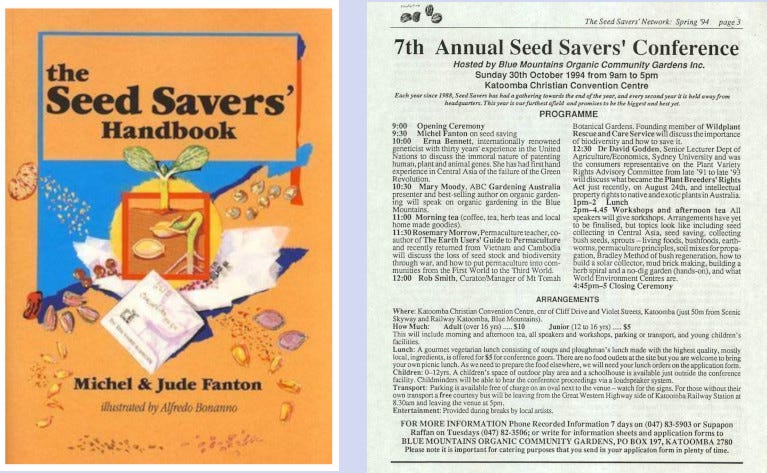
With Supapon and myself at the centre, we set about organising the 7th Annual Seed Savers’ Conference. Somewhere, somehow we recollected that there was a woman who lived up Bathurst Road who knew a bit about seeds. So we asked Erna to speak.
Next thing the ABC was contacting us anxious to interview her. I recall the interviewer, Alan Saunders describing her cool passion (in the Borschmann interview Erna explained she was a good shot). It was an extraordinary half hour for the content and quality of the information it conveyed.
The Seed Savers’ Conference was held a mere three weeks before Erna headed overseas and she was magnificent. As Gregg Borschmann’s tape predicted, Erna was gone before the end of the year but she returned to Katoomba after a year or two. All official records have her leaving Australia in 1994 and not returning. I started to wonder whether my recollection of events was jumbled until my wife confirmed Erna’s return and my recollection (see postscript).
Following the conference, Erna and I became friends and I recollect her bemusement and enjoyment at my struggles with Council. She always placed great emphasis on and urged me to read about the Spanish Civil War. The Borschmann interview described her deep interest in this event going back to childhood.
What you might miss with all this fighting, questioning and standing up to authority is Erna’s wonderful sense of humour. The Fragile Harvest film will also give you a sense of her capacity to make a point stick in memory long after it was made. And there was the majestic way she used her hands in conversation.
What an amazing woman.
PS: Sometimes our best sources of information are close at hand. My wife, Donna, confirmed that Erna and Pru returned about a year later and gave her an olive tree wood cutting board that they brought back from Greece. Now, I can fit in that Communist Party meeting I attended at Erna’s place into the picture. I didn’t join and only attended the one meeting. She might today accuse me of “survival over spiritual purity”.
Erna Bennett interviewed by Gregg Borschmann in the Environmental awareness in Australia oral history project
21st November 1994
Erna Bennett - ABC Oral History Tape 1, 58m 11s.
Rhodesian Tobacco Association
formed in 1948
Nikolai Vavilov
Devoted his life to the study of the genetics of cultivated crops. This Crop Trust link to him snakily refers to him as the inventor of gene banks as though this is nothing new.
Euginiya Sinskaya - Global Plants
She was Head of the Taxonomy, Ecology and Geography Division at the Institute of Plant Industry (VIR), St Petersburg
Erna Bennett - ABC Oral History Tape 2, 20m 10s
Chickpea genetic resources: collection, conservation, characterization, and maintenance
In situ germplasm conservation is used for the preservation, and maintenance of population in their natural surroundings
from Science Direct
The Doomsday Vault:
The Svalbard Global Seed Vault (Norwegian: Svalbard globale frøhvelv) is a secure backup facility for the world's crop diversity on the Norwegian island of Spitsbergen in the remote Arctic Svalbard archipelago. The Seed Vault provides long-term storage for duplicates of seeds from around the world, conserved in gene banks. This provides security of the world's food supply against the loss of seeds in genebanks due to mismanagement, accident, equipment failures, funding cuts, war, sabotage, disease, and natural disasters. The Seed Vault is managed under terms spelled out in a tripartite agreement among the Norwegian government, the Crop Trust, and the Nordic Genetic Resource Center (NordGen)….The Norwegian government entirely funded the Seed Vault's approximately 45 million kr (US$8.8 million in 2008) construction cost. Norway and the Crop Trust pay for operational costs. Storing seeds in the vault is free to depositors.
Erna Bennett - ABC Oral History Tape 2, 41m
”All my colleagues in the UN, almost without exception, not without exception, are very altruistic people. Who are moved by quite genuine considerations of wanting to help the world. After all, when I first, as a very young person, looked at the direction I was taking I was thrilled by the idea of making two blades of grass where one grew before. So the notion of creating wealth by creating more is almost instinctively seeded in our brains but it is a very incorrect idea and its an idea that still inflames many of my colleagues in the UN who still think because the world is hungry we must produce more food. Nobody or very few have stopped to ask themselves is it really short of food? Is the world really not producing enough? And the odd thing is that people don't look at the most obvious sources for information of this sort. The FAO itself produces a production Yearbook each year in which the number of people in the world is listed and the number of tonnes of each crop that is produced in the world is also listed and by doing simple division and conversion into calories you can find the world is producing more than enough food to satisfy the needs of everybody. Its not a question of whether the world is producing enough food and whether we need to produce more. It is a question of who can afford to buy it or can we distribute it fairly which of course brings us to social and political considerations that have nothing to do with increasing yields. And the appeal that you mention to idealist notions of filling a void and helping to fill empty bellies is and I make no bones about it is a purely cynical appeal by seed corporations who use this to sell their product. The problem that we're facing is a problem of hunger. Hunger is caused by poverty. Wherever there's a famine, whether it be Ireland or Bangladesh, the rich don't die from it and never have. It is the poor who die from famines. It is the poor who are hungry whether there are famines or not and this is not going to be solved by increasing the yields of crops. What is going to be solved by increasing the yields of crops are the profits of farmers or much more likely the profits of those who sell farmers their very high cost inputs because you see the Green Revolution was not just a revolution of introduced varieties that yield highly. They only yield highly if they are privileged in a whole number of ways. Enormously meticulous preparation of the land, of the seed bed, which requires mechanisation, which the poor farmer doesn't have, the application of high doses of fertiliser, which the rich farmer can afford but the poor farmer cannot and then the application through the season of sometimes as many as a dozen and sometimes more depending on the crop of pesticides, at different stages for different pests, or simply to reinforce what went before”.
Jonathan Couey’s Gigaohm Biological
An essential resource for anyone seeking to understand the Covid era and Big Tech’s plans for our health future
Chapter 11 - Crop Genetic Diversity under the CGIAR Lens
from Part III - Science in the System
from Agricultural Science as International Development
Erna Bennett - ABC Oral History Tape 2, 1hr 11m
Sir John Crawford
Entry in Australian Dictionary of Biography
https://adb.anu.edu.au/biography/crawford-sir-john-grenfell-jack-1391
History of the CGIAR
Wayback Machine 3/2/2007
Genetic Resources in Plants
Proceedings of 1967 Rome Conference
O. Frankel, E. Bennett. 1970
You can borrow a free version of this book through Internet Archive
but you will need to sign up.
The Seeds of the Earth - a private or public resource
by Pat Roy Mooney
Introduction to the Garden Seed Inventory
Ceres Trust
Very timely reminder re the necessity of protecting our strong and viable seed varieties. My passion, being a biodynamic beef farmer, is pasture herbage to provide diverse and vigorous plant grazing species for my cattle. The cost and quality of conventional pasture seeds...plus their poor or non existent reproductive capacity....becomes yet another burden for those of us who want to farm for a healthier future.
Here's a hint. Pasture reared cattle fart very little, for those with persistent climate anxiety. In fact they are a net carbon benefactor as they graze. Herbage is a fast grower and hungry for lots of atmospheric carbon. We love carbon here.
Compare a man who exists on processed foodstuffs to one who eats fresh natural untainted (as far as they can be in this world) food. Who will fart more with belly pains?. Then examine a steer standing flank by flank with a whole lot of confined beasts on concrete being force fed at best corn and soy based pellets. Who is going to have chronic digestive complaints farting helplessly into the atmosphere?
A good read Warren, is Fiat Food by Matthew Lysiak, inflation being a deliberate policy to drain the small remainder of our personal resources to the financial classes and their political lackeys, in part to force us to eat their vile synthetic food to make us sick and so feed into the pharma/ medical dystopia etc etc.
The thing about resistance is though, it does make you stronger. Your 6'3" Irish ( God bless the Irish!) friend being a case in point. Keep up the good work
Cheers Simon
Very interesting parallels between Erna's exposing of those who wanted to "save"/control the plant gene pool and Jay Couey's unveiling of the eugenics project to collect human DNA sequences, the "Human Genome Project", which is most likely still collecting the medical remnants from millions of "PCR swabs" to be sequenced and fed to the AI. The reductionist technocrat transhumanist project whose motto must be "DNA über alles".